
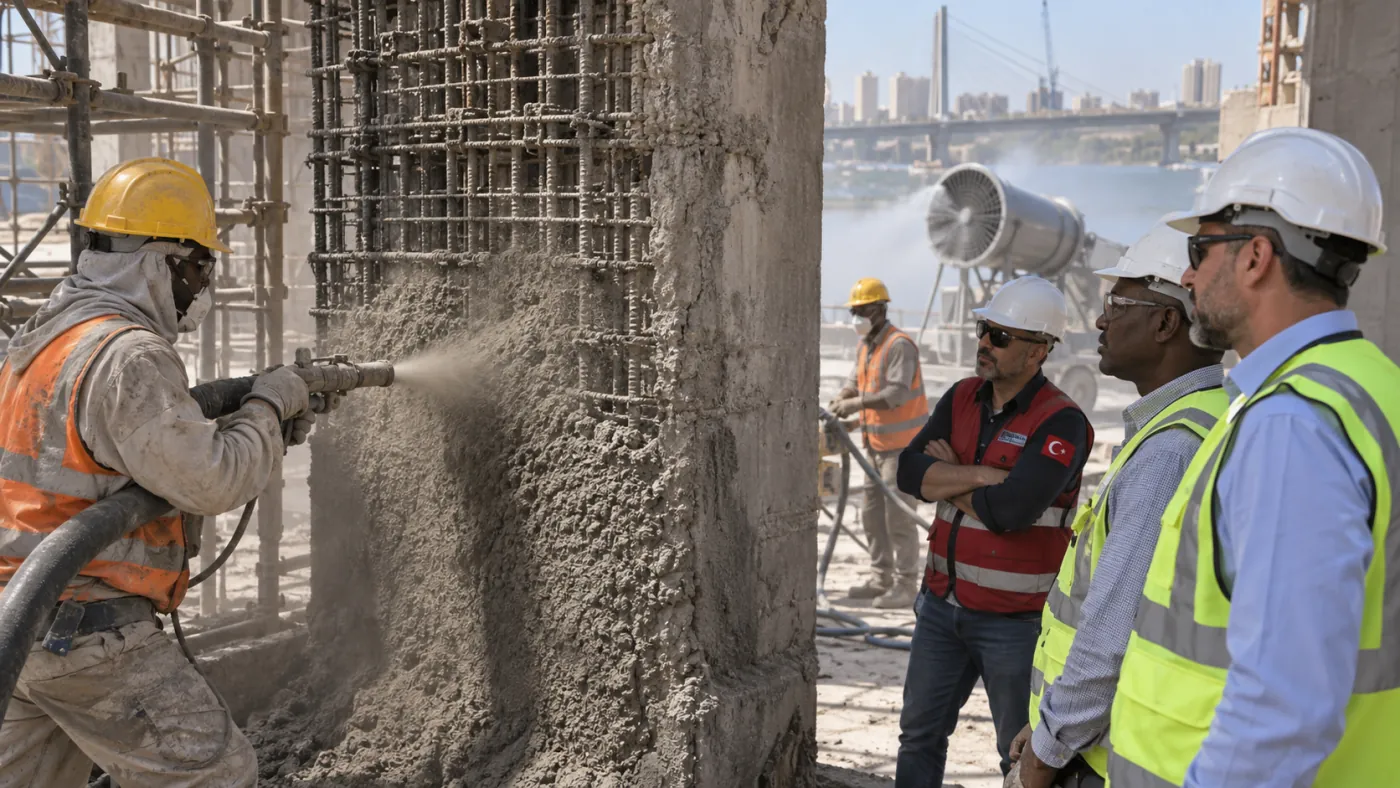
What is shotcrete strengthening?
Shotcrete strengthening applies sprayed concrete or mortar to a correctly prepared and detailed substrate, often with designed mesh or reinforcement, to build a repair or strengthening layer.
What it solves
It may be appropriate for walls, soffits, shells, retaining or infrastructure elements where access and geometry suit sprayed placement and engineering design defines reinforcement and load transfer.
When it may not be suitable
Shotcrete quality depends on substrate preparation, reinforcement detailing, equipment, nozzle control, rebound management, thickness control, curing and inspection. It is not simply a surface coating.
Typical applications
- Strengthening layers on walls and soffits
- Reinforced repair over complex geometry
- Retaining and water-related structures
- Infrastructure rehabilitation
Execution workflow
- Review assessment and design basis
- Confirm method, access and compatible system
- Prepare substrate and control the work area
- Install or apply under documented procedure
- Inspect, record and hand over
Materials and systems
A system may include dowels, designed reinforcement or mesh, bonding or pre-dampening procedures, wet- or dry-mix shotcrete, finishing, curing and protection appropriate to the exposure.
Product families are selected generically at planning stage and specified only after compatibility, performance requirements and site conditions are confirmed.
Quality control approach
Controls are matched to the intervention and may include substrate acceptance, batch and shelf-life checks, mixing records, temperature and moisture readings, installation sequencing, pull-off or proof testing where specified, photographic records and signed inspection points.
Limitations and engineering considerations
What we need before we recommend this method
A photograph can help start the conversation, but it cannot establish a structural diagnosis on its own. Useful inputs include:
- Photographs showing the wider structure and the defect
- Available drawings, reports or previous repair records
- Crack, leakage or deterioration history
- Known movement, loading or change-of-use information
- Access, occupancy and shutdown constraints
- Available substrate tests or condition data
Frequently asked questions
It may be appropriate for walls, soffits, shells, retaining or infrastructure elements where access and geometry suit sprayed placement and engineering design defines reinforcement and load transfer.
No. Suitability depends on verified condition, engineering requirements, substrate, exposure, access and the intended service life. Project-specific assessment and design may be required.
The project method should define substrate acceptance, material checks, environmental limits, installation records, hold points, inspection and handover documentation appropriate to the system.