
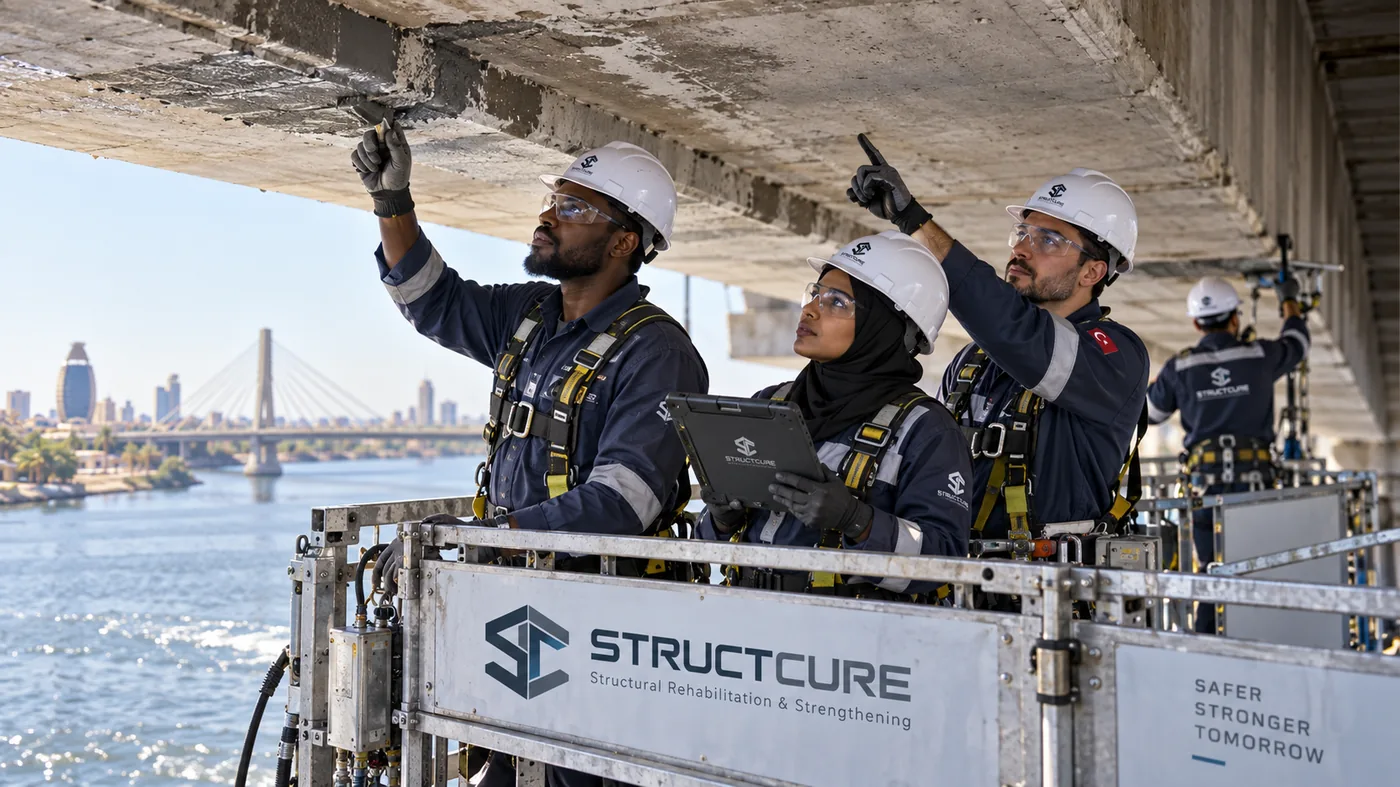
What is bridge & infrastructure rehabilitation?
Bridge rehabilitation combines condition-led repair, strengthening, protection and staged execution to extend the safe service life of infrastructure assets.
When is it appropriate?
It is considered when deterioration or capacity concerns can be addressed through a verified intervention rather than immediate replacement.
Typical applications
- Deck and soffit repairs
- Pier and abutment rehabilitation
- Joint and water-management work
- Localized strengthening and protection
Execution workflow
- Review assessment and design basis
- Confirm method, access and compatible system
- Prepare substrate and control the work area
- Install or apply under documented procedure
- Inspect, record and hand over
Materials and systems
Depending on design, works may use repair mortars, micro-concrete, crack injection, corrosion-control systems, CFRP, bonded anchors, waterproofing and protective coatings.
Product families are selected generically at planning stage and specified only after compatibility, performance requirements and site conditions are confirmed.
Quality control approach
Controls are matched to the intervention and may include substrate acceptance, batch and shelf-life checks, mixing records, temperature and moisture readings, installation sequencing, pull-off or proof testing where specified, photographic records and signed inspection points.
Limitations and engineering considerations
Frequently asked questions
It is considered when deterioration or capacity concerns can be addressed through a verified intervention rather than immediate replacement.
No. Suitability depends on verified condition, engineering requirements, substrate, exposure, access and the intended service life. Project-specific assessment and design may be required.
The project method should define substrate acceptance, material checks, environmental limits, installation records, hold points, inspection and handover documentation appropriate to the system.