What is reinforced concrete jacketing?
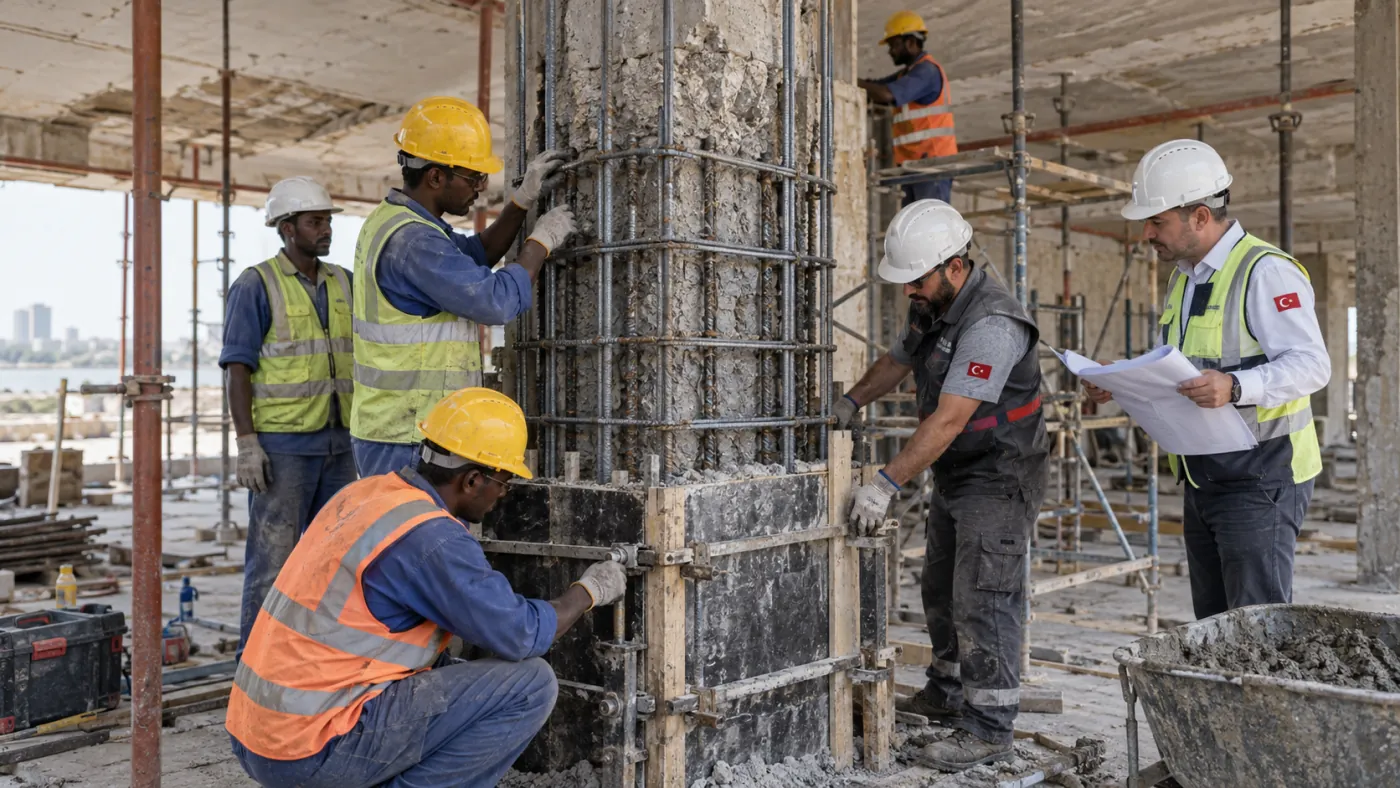
Reinforced-concrete jacketing adds designed reinforcement and a compatible concrete or mortar jacket to improve selected member capacity, stiffness or confinement.
What it solves
It may suit columns, beams or piers where engineering design requires a reinforced jacket and the existing member, interfaces, connections and foundations can support the modified behavior.
When it may not be suitable
Jacketing adds mass, stiffness and section size. Load transfer across the interface, reinforcement detailing, foundations, connections, shrinkage, access and construction sequence require project-specific design and control.
Typical applications
- Column and pier jacketing
- Member confinement
- Added longitudinal and transverse reinforcement
- Concrete member strengthening
Execution workflow
- Review assessment and design basis
- Confirm method, access and compatible system
- Prepare substrate and control the work area
- Install or apply under documented procedure
- Inspect, record and hand over
Materials and systems
The system may include post-installed dowels, added reinforcing steel, interface treatment, formwork, compatible flowable concrete or micro-concrete, repair materials and curing or protective systems.
Product families are selected generically at planning stage and specified only after compatibility, performance requirements and site conditions are confirmed.
Quality control approach
Controls are matched to the intervention and may include substrate acceptance, batch and shelf-life checks, mixing records, temperature and moisture readings, installation sequencing, pull-off or proof testing where specified, photographic records and signed inspection points.
Limitations and engineering considerations
What we need before we recommend this method
A photograph can help start the conversation, but it cannot establish a structural diagnosis on its own. Useful inputs include:
- Photographs showing the wider structure and the defect
- Available drawings, reports or previous repair records
- Crack, leakage or deterioration history
- Known movement, loading or change-of-use information
- Access, occupancy and shutdown constraints
- Available substrate tests or condition data
Frequently asked questions
It may suit columns, beams or piers where engineering design requires a reinforced jacket and the existing member, interfaces, connections and foundations can support the modified behavior.
No. Suitability depends on verified condition, engineering requirements, substrate, exposure, access and the intended service life. Project-specific assessment and design may be required.
The project method should define substrate acceptance, material checks, environmental limits, installation records, hold points, inspection and handover documentation appropriate to the system.